Artificial intelligence (AI) is reshaping how organizations approach health and safety (H&S). It is already being applied across H&S in practical, well-defined workflows, from incident management to compliance monitoring, where it is delivering clear value.
But as AI capabilities mature, the challenge is shifting from identifying individual use cases to understanding how H&S operating models should evolve to capture value at scale. The real prize is not greater automation, but increased impact through stronger leadership, confident decisions, earlier intervention and more effective engagement with operations.
While every organization is at a different stage in its AI journey, most organizations are approaching AI adoption in H&S from one of three stages, as shown below.
Three common stages of AI adoption in H&S
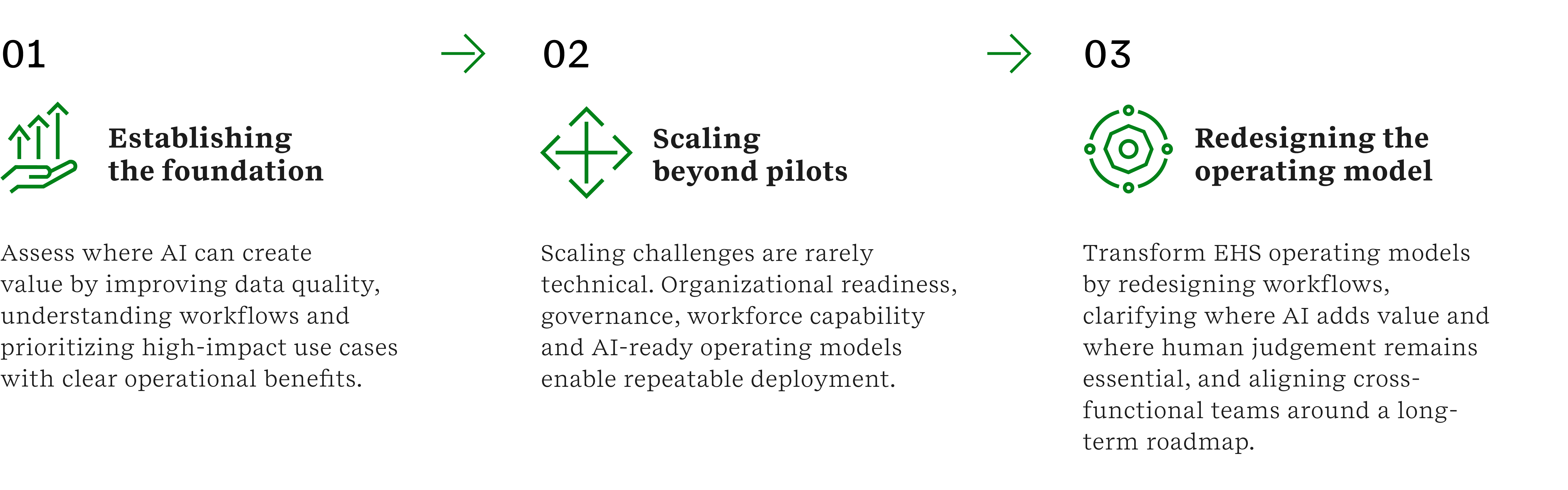
Across all three of these stages, the broader challenge remains the same: ensuring AI strengthens how H&S creates operational value rather than simply digitizing existing processes.
Download All Six Insights
Six insights around AI for H&S functional leaders
We held a series of AI in H&S roundtables, convening leaders from leading companies across industries to explore both the opportunities and challenges of AI adoption. While many H&S leaders recognize AI's potential to address capability and capacity gaps, significant uncertainty remains around how best to apply it within H&S operating models.
What H&S Functional Leaders are telling us
Drawing on recurring themes from these discussions, together with ERM's implementation experience, we have identified six insights that are emerging as priorities for H&S functional leaders.
Insight 1: Most H&S data is still not fit for AI-supported decisions
Benefit: Better data quality and more reliable insights
Most H&S functions are sitting on years of operational data that are difficult to use effectively. The challenge is rarely data volume, but data structure.
This is particularly true for H&S workflows where problems are well defined and data is structured. Beyond these areas, and across the broader EHS function, many organizations still face uncertainty about where and how AI can be applied effectively, even as regulatory expectations and operational complexity continue to increase.
During our AI in H&S roundtables, feedback from approximately 50 multinational companies, across Europe, the Middle East, and Africa, highlighted a common challenge: fragmented systems, inconsistent narratives, weak classification, and poor comparability across sites were major barriers to trusted insight.
H&S teams often hold large volumes of information across incidents, audits, observations, permits to work, management of change, and maintenance and compliance systems, but much of it is not consistent or comparable enough to support AI-enabled decision-making.
AI does not create value from data volume alone. It creates value when raw inputs can be transformed into reliable signals that support prioritization, intervention, and better decisions.
That makes data readiness a practical starting point rather than simply a technical exercise, and a prerequisite for scaling AI across H&S workflows. Verdantix similarly identifies data readiness, structured workflows, workforce capability, and governance as key foundations for scaling AI in H&S.
|
Case study: Turning 32,000 Hazard Records into Clearer Risk Priorities
A manufacturing organization was managing large volumes of hazard observations, but inconsistent narratives and incomplete tagging limited its ability to generate reliable insight. ERM applied an AI-supported data cleansing and enrichment across 32,000 H&S records, improving classification, consequence prediction, and prioritization. The result was stronger risk targeting, more reliable leading indicators, and reduced manual effort processing H&S data.
|
Insight 2: AI agents create value when they support decisions, not just reporting
Benefit: Better decision quality, faster triage, and more targeted action
Building more dashboards alone does not improve outcomes. Value comes from connecting H&S data to the decisions that shape operational performance.
The strongest AI use cases in H&S – specifically agents – are linked to specific decision points in operational workflows. Workshop participants highlighted opportunities across incident intake, classification, pattern detection, root-cause analysis, hazard recognition, and real-time alerts. The common thread was not the technology itself, but the ability of AI to help the right people act faster, prioritize earlier, and intervene more effectively.
This shifts AI from a reporting tool to a decision-support capability embedded within operational workflows. The greatest value comes when AI outputs are embedded and support triage, escalation, prioritization, investigation and resource allocation, enabling faster decisions and clearer action.
|
Case Study: Real-Time Monitoring for Earlier Safety Intervention
A rail operator required faster and more consistent safety monitoring across high-risk operations. AI-enabled visual intelligence was used to analyze live and archived Closed-Circuit Television (CCTV) footage, identify unsafe proximity events, and enable faster risk identification. This improved situational awareness, accelerated signal detection, and enabled more targeted intervention.
|
Insight 3: If AI only improves administration, it has missed the point
Benefit: Greater capacity for frontline engagement and risk intervention
The capacity argument is real, and it is the right starting point. But if the time AI releases is simply absorbed back into administration, organizations have paid for efficiency without realizing its full value.
Our Global Health & Safety Survey highlights a clear ambition: H&S leaders want to spend more time influencing decisions, strengthening safety culture, and engaging with operations. The survey drew on the perspectives of approximately 250 H&S leaders representing organizations with combined revenues of $7.2 trillion and more than 11 million employees and contractors across 150 countries. However, in practice, much of the function’s time is still consumed by reporting, coordination, and managing fragmented information across multiple systems. These insights are illustrated in the figures below.
What H&S leaders want to spend more time on and what prevents them:
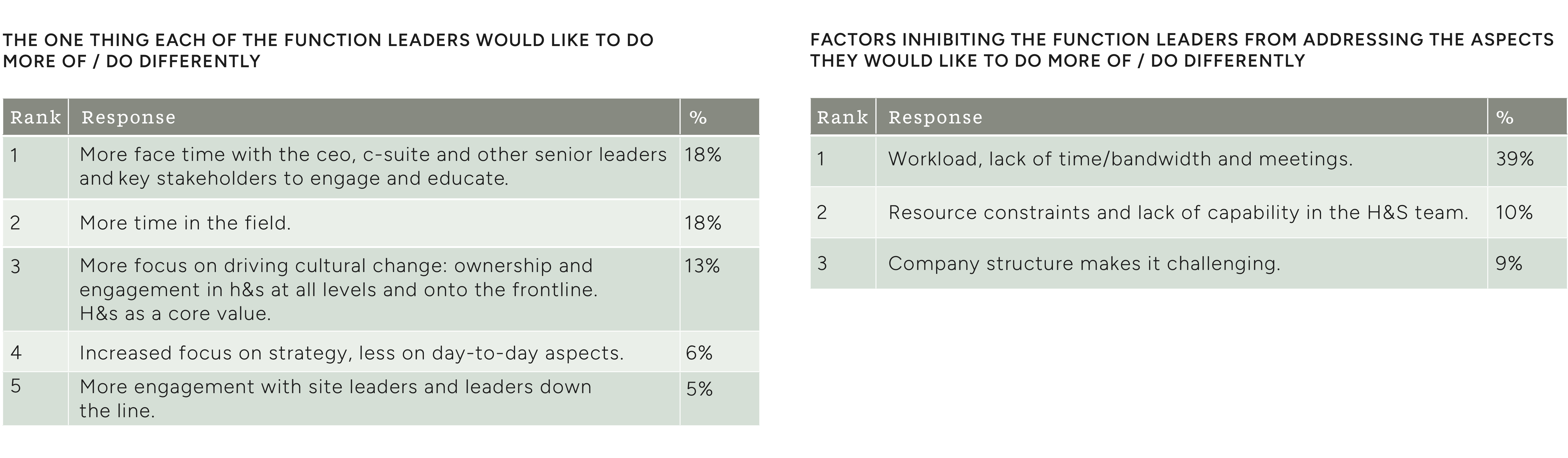
AI can reduce repetitive work across reporting, classification, regulatory monitoring and information processing. Capacity relief is therefore one of the most credible early benefits of AI adoption, helping H&S teams spend less time processing information and more time in the field, reviewing risk, supporting learning and intervening where performance is shaped.
The strategic opportunity extends beyond efficiency. The same AI models that clean and classify historical data can often improve how new H&S information is captured and categorized, reducing manual effort while improving signal quality. However, lasting value depends on whether the time saved is deliberately reinvested into higher-value work.
In practical terms, this means more time to:
- Engage with frontline teams to build trust and identify risks earlier
- Support operational decision-making in real time
- Strengthen safety culture and behaviours, and
- Shape strategy, capability, and system design
As wider organizational experience with AI demonstrates, automation only creates lasting value when roles and workflows are redesigned to support better decisions and stronger performance.
Download All Six Insights
Insight 4: In H&S, trust and governance will determine adoption of AI
Benefit: More trusted outputs and more consistent decisions
An AI system that people do not trust will not be used. One that is trusted too much creates new risks. Building trust is therefore a design challenge, not simply a communications challenge.
Transparency, validation, privacy, cultural sensitivity and oversight are conditions for AI adoption in H&S. AI outputs may be technically robust, but they will only be used consistently if people understand how they are generated, how they should be interpreted and where accountability sits.
For example, visual intelligence can identify repeated exposure patterns more consistently than manual review, but its value depends on outputs that are explainable, trusted and linked to clear action. Without this, AI risks being ignored or over-relied on.
AI does not remove liability. It increases expectations around ownership, excalation, validation and auditability. Organizations need clear human oversight for safety-critical and compliance-related decisions, supported by defined validation and escalation processes.
|
Example: Thousands of Requirements, One Source of Truth
Many organizations continue to face evolving regulatory requirements across multiple sites and jurisdictions. Libryo combines AI-enabled regulatory monitoring with ERM's regulatory expertise to identify applicable requirements, assign compliance actions, and support ongoing reporting and oversight. This improves compliance visibility, clarifies ownership, and reduces manual monitoring effort.
|
Workforce trust is equally important to AI adoption. People need confidence that AI supports learning and performance improvement rather than surveillance or sanction.

Insight 5: Most AI pilots struggle to move beyond experimentation
Benefit: More scalable and repeatable deployment across workflows
Many organizations already have evidence that AI can create value in H&S workflows. The challenge is no longer proving the technology but scaling it effectively.
The strongest starting point is a well-defined H&S problem within a specific workflow, where value can be demonstrated before broader deployment. Examples include AI-supported incident triage or visual intelligence to identify repeated exposure patterns and enable more targeted intervention.
Sustainable progress depends on more than one successful pilot - it requires clear ownership, governance, workforce capability, and operating models that support repeatable AI-enabled workflows at scale.
Scaling AI in H&S is not simply a technology rollout; it is an organizational change challenge requiring stronger alignment between H&S, operations, digital, IT, and leadership teams.
Insight 6: An opportunity to move from AI use cases to an AI-enabled H&S operating model
Benefit: Stronger H&S performance, learning, and resilience
What starts as targeted use cases quickly exposes a broader reality: while AI can deliver value across parts of H&S, the broader H&S function and the wider EHS operating model are not yet structured to take full advantage of it at scale. As organizations expand AI across H&S, familiar challenges emerge; workflows remain disconnected, data doesn’t flow effectively, and ownership becomes unclear.
At the same time, the H&S function has a unique opportunity to shape how AI is embedded into the operating model. It can wait for an AI-enabled operating model designed by others, or it can lead its design.
The most important strategic shift is to stop treating AI as a series of isolated tools and start embedding it into how H&S work gets done. This shifts AI from a technology discussion to a business transformation decision. Success depends as much on governance, leadership and ways of working as it does on the technology itself. The question is no longer whether AI can support EHS, but how the function must evolve to use it effectively.
This is where the Human and Organizational Performance (HOP) lens becomes important. Applied effectively, AI can do more than detect deviations or automate reporting. It can reveal exposure patterns, operational pressures, weak barriers, and ineffective systems, organizations learn earlier and intervene sooner rather than simply identify non-compliance.
Realizing this potential requires redesigning workflows end-to-end, defining where AI supports insight, classification, escalation or monitoring, and where people retain responsibility for judgment, accountability, learning and building relationships.
The organizations most likely to realize lasting value are those that treat AI in H&S as an operating-model transformation rather than a technology initiative.
What’s next for H&S professionals
These insights show that the path to AI-enabled H&S does not start with technology alone. It starts with better data, clearer decisions, trusted governance, and a deliberate shift from isolated use cases to redesigned ways of working.
As AI adoption accelerates, the opportunity for H&S leaders is not simply to automate existing processes, but to reshape how the function creates value across the business. Organizations that actively build the foundations for scale today will be better positioned to realize lasting value from AI in the years ahead.
Download All Six Insights