
The energy transition is under strain: offshore wind tenders are failing, industrial electrification is progressing slowly, and grid congestion is rising. Transmission system operators (TSOs) must take a proactive role to lead the shift to a net-zero power system. This requires clear messaging of the causes and impacts of the energy transition, how it affects different stakeholders, and what is required to recalibrate roles and responsibilities to ensure stakeholders can and will work together to combat climate change.
If TSOs remain reactive, they will face mounting criticism over soaring grid investment costs and persistent delays in delivering grid reinforcements and expansions. Instead, they should focus on presenting realistic and affordable scenarios towards a net-zero energy system, where grids are not designed for peak demand but rather incorporate a systematic approach, including storage, flexible demand, and location-specific policies and obligations to maximize utilization of the infrastructure. In this recalibration process, the TSOs should not be afraid to question their own role and the appropriateness of current decision-making and mandates.
What happens when transitioning to a sustainable energy system?
Looking at the electricity system, the energy transition involves replacing fossil-based electricity generation with variable renewable energy (VRE) sources (primarily solar and offshore and onshore wind). Decarbonization of the energy system as a whole requires significantly increasing the share of electricity in the energy mix (electrification) and using electricity for sustainable feedstock generation. This general transition has two main effects.
- Relocation of generation traditionally located close to the large industrial demand centers, to locations where there are optimal renewable resource conditions (e.g., offshore wind far from the coast or large-scale solar generation in remote areas). This results in a spatial mismatch between generation and demand and, generally, a need to increase transport capacity over longer distances. This also requires considering how to localize new electricity demand, ensuring that grid capacity can be realized efficiently and at minimal societal cost.
- Variability of generation. In the case of renewables, generation profiles no longer follow demand fluctuations because they are driven by weather. This implies an inherent temporal mismatch between generation and demand. As the grid balances supply and demand instantaneously, grid reinforcements do not fundamentally solve this issue (although interconnection to markets with a significantly different energy mix may contribute to the solution to some extent).
Due to the variability of renewable generation, the peak capacity of renewables is inherently much larger than the peak demand required to meet overall annual energy demand. Traditionally, the grid is designed for peak demand. Designing the grid to peak generation would result in an “insane grid” without addressing the core issue: the temporal mismatch.
To successfully integrate higher levels of solar and wind energy into the grid will thus increasingly rely on having adequate measures in place, critically electricity grids (including expansion, modernization, and upgrades), and procuring flexibility from a broad range of assets, such as electrical storage and the conversion of excess electricity into hydrogen. The latter also needs to address the ability to absorb vast amounts of (peak) energy from offshore wind near the onshore landing points, to avoid putting unnecessary and inefficient requirements for reinforcement of the onshore grids.
The IEA recently published a comprehensive report that outlines the subsequent phases and associated challenges for countries undergoing the energy transition. It also evaluates which countries are currently in which phase of the energy transition and when they are expected to progress to the next phase (see Figure 1). Many North Sea countries, including Spain, the United Kingdom, Germany, and the Netherlands, are currently in a phase of the energy transition (“phase 4”) in which variable renewable energy (VRE) meets almost all demand at some times during the year. In the coming years, these countries are moving towards phase 5, meaning significant volumes of VRE surplus will occur across the year. Denmark has already reached phase 5, and Ireland is expected to do so in 2030.
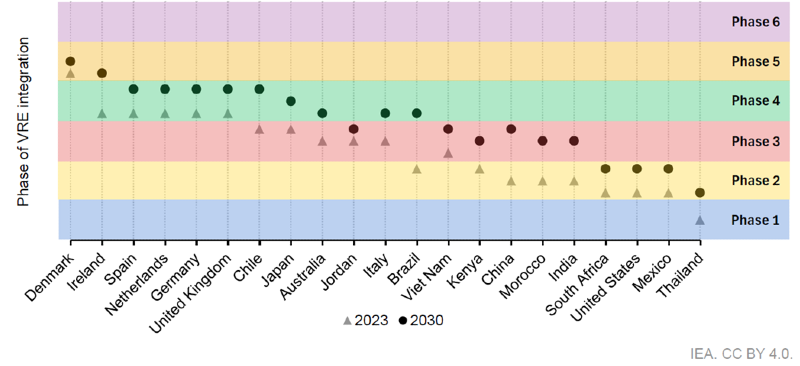
Figure 1: Selected countries By phase of variable renewable integration, 2023-2030. SOURCE: IEA
As the temporal mismatch between VRE supply and demand becomes significant for system operations, this phase of the energy transition requires substantial action to ensure sufficient system flexibility. Action for which the current setup of grid planning and operation, and the distribution of roles and responsibilities between TSOs and market parties, was not designed.
The need for flexibility – the Denmark example
Denmark is at the forefront of the energy transition, with high levels of VRE penetration in the power system and significant periods throughout the year when VRE infeed either drastically exceeds or falls far short of actual demand for varying durations. Figure 2 compares the actual situation over several time horizons with a scenario in which Denmark would have a 100 percent renewable energy mix. As the chart shows, a 100 percent renewable scenario would further increase the swings.
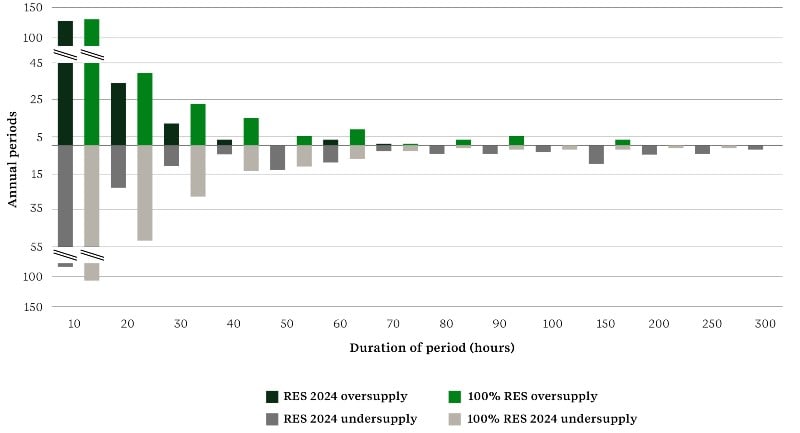
Figure 2: analysis of prolonged RES over- and undersupply for the danish power system in 2024 and scaled to a 100 percent res scenario. Source: ERM
As the significant excesses and shortages demonstrate, the Danish power system has a strong need for flexibility measures to avoid excessive curtailment and enable the efficient use of VRE oversupply in periods of VRE undersupply. Note that some of the oversupply and undersupply may in practice be covered by VRE exports and imports to other energy markets, which are not included in the chart.
In the 100 percent renewable energy scenario, the need for smart flexibility measures would expand dramatically. The alternative would be massive curtailment, which is costly, or massive long-distance export/import flows to balance out weather patterns and day/night rhythms, which would take an insane grid.
What are the options to increase flexibility?
There is a range of options to increase flexibility in the electricity and broader energy systems. They operate on different timescales, use a wide range of technologies, and can be categorized by functionality.
- Flexible demand – refers to measures that adjust energy consumption to match generation profiles, minimizing contribution to peak demand and shifting usage to periods of excess supply and lower prices. This often involves changing operational practices and using market incentives. Non-firm grid connections, in which consumers accept limited guaranteed access for lower costs, give TSOs more options during grid congestion.
- Electrical storage – usually in the form of batteries allows storage of excess generation power and feeding this back into the grid in times of low generation of renewables.
- Sector coupling (P2X) – where electrical power (P) is transformed into another energy carrier (X), such as hydrogen or heat. This serves as a flexible demand option, where it changes the profile of electricity consumption by end appliances (such as heat pumps and electrolyzers). Sector-coupling may also be essential for absorbing “excessive” peak loads from offshore wind reaching the coastal landing points. Such mega “dampers” (e.g., properly located electrolyzers or electrified industries) can act as peak shavers, before energy is transmitted further inland.
- In combination with storage, sector-coupling can also serve as carbon-free dispatchable power[1]. To cover prolonged periods of low renewable generation, such as solar and wind, stored renewable energy, for instance, in green hydrogen, can be used to generate CO2-free electrical power.
- Interconnection - used to transmit electricity between different intra- or international price zones. In cases where the two price zones have significantly different energy mixes and weather patterns, such interconnection also contributes to system balancing.
How would a future energy system operate?
The advanced phases of the energy transition, with high levels of renewable energy supply and increased electrified demand, require some significant adaptations to support the operation of current and future energy systems. This involves the following four core principles:
- Coordinated planning of the energy system: To achieve a net-zero energy system at minimum societal cost, coordinated national planning is needed across the different functionalities of the system: renewable energy generation, connecting infrastructure, storage, and demand flexibility. This coordinated planning should be based on stakeholder consultation and techno-economic modeling. This would lead to a “master plan” for efficient infrastructure development rather than siloed independent decisions. This also ensures alignment between different infrastructure deployments – e.g., the location and rate of network upgrades – with new renewable energy supply and demand siting.
- Energy market design and regulatory framework that supports the transition to net-zero: In this new paradigm, markets exist to deliver new renewable generation, flexibility, and infrastructure via efficient deployment of capital, in support of coordinated and integrated planning to ensure that nature, location, timing, and sizing of the measures drive towards a cost-optimal net-zero renewable power system.
- Consumer engagement for demand flexibility: Flexible demand from heating, EV, and industry significantly contributes to reducing the infrastructure needs in a cost-optimal system. Consumer engagement and the use of smart controls/aggregators are needed to maximize the technical potential of demand flexibility.
- Uniform implementation of permitting rules across the EU and grid access that prioritizes projects that maximize the use of their grid connection and contribute to accelerated system integration.
What can system operators do and what do they need?
The required transition to a net-zero energy system calls on system operators to take a stronger proactive role. Operators need to take policymakers by the hand and, in close collaboration with all stakeholders, guide and lead the energy transition of the power sector. This requires calls for action on several fronts:
- Provide full and substantiated transparency on the need and limitations of grid expansion for the energy transition.
- Present realistic and affordable scenarios that do not design for peak demand and incorporate a systematic approach, including storage, flexible demand, and location-specific policies and obligations, starting from a net-zero energy system end-goal.
- Work with stakeholders (government, generators, industry, NGOs, and others) – through a structured and informed stakeholder consultation process – to seek and ensure long-term sustainable solutions, from a “best for society” perspective, addressing the fundamental challenges.
- In all activities: set the standard for contributing to sustainability, security, safety, and human rights: resilience, circularity, and biodiversity must be baked in from the start.
Together with policymakers and the private sector, roles and responsibilities should be recalibrated to ensure each can play their part in advancing the energy transition.
[1] Dispatchable power refers to electricity from power generation sources that can be turned on or off, or have their output increased or decreased, based on demand to match fluctuating electricity demand which is not matched with renewable energy generation. This reliability is crucial for grid stability and is provided by resources like nuclear, coal, natural gas, and hydropower plants, as well as certain renewable technologies paired with storage, such as concentrated solar power and biomass.