

 View all
The next edition of ISO 14001 is nearly here, and this revision represents a material shift in what credible environmental management looks like. This is the first update to ISO 14001 since 2015, and in that time the sustainability landscape has transformed: climate change, nature loss, supply‑chain expectations, disclosure requirements, and stakeholder scrutiny have all intensified. The 2026 revision reflects this new reality and sets a higher benchmark for environmental performance.
With the Final Draft International Standard (FDIS) for ISO 14001:2026 now released, organizations have clear visibility into the direction of the changes and a timely reminder that environmental expectations are shifting rapidly. The revision raises the bar on climate awareness, lifecycle responsibility, supplier oversight, environmental governance, and leadership accountability. These changes are not incremental, and they require organizations to reassess how environmental decisions are made, managed, and evidenced across the business.
At ERM CVS, we view the 2026 update as a meaningful opportunity for organizations to strengthen environmental governance, sharpen decision making, and embed more robust and future-ready practices across their EMS. Below, we outline what’s changing, why it matters, and how to prepare for transition with confidence and purpose.
1. Why ISO 14001 remains critical for environmental management
ISO 14001 remains the global benchmark for credible, structured environmental management and the 2026 revision reinforces just how essential a mature EMS has become. The standard helps organizations:
- Manage environmental impacts with consistency, discipline, and traceability
- Meet tightening regulatory and compliance obligations
- Demonstrate trustworthy sustainability performance to customers, investors, and stakeholders
- Integrate environmental risks, opportunities, and governance into broader business decision‑making
As climate change, biodiversity loss, resource constraints, and disclosure expectations intensify, ISO 14001 is no longer just a best-practice framework - it is a critical foundation for organizations building environmental resilience and maintain stakeholder trust.
Importantly, the 2026 revision also strengthens alignment with other ISO management system standards, including ISO 9001, ISO 45001, ISO 50001, and ISO 27001. By modernizing terminology and reinforcing Annex SL structure, the update makes it even easier for organizations to build an integrated, efficient, and coherent management system; one that reflects today’s sustainability realities and supports more streamlined governance, risk management, and operational excellence across functions.
This enhanced alignment ensures the standard remains relevant, practical, and strategically valuable for organizations navigating rapidly evolving environmental and stakeholder expectations.
2. Where are we now with ISO 14001:2026 FDIS
The Final Draft International Standard (FDIS) for ISO 14001:2026 was released on January 5, 2026 confirming the technical content of the revised standard and providing organizations with early clarity on what the updated requirements will entail. This means the expectations are now effectively set, and organization can begin preparations with confidence ahead of formal publication
With publication expected in April 2026, this period represents a critical window for organizations to begin strengthening competence, reviewing environmental aspects and impacts, aligning governance structures, and assessing where updates will be needed across their EMS. Early preparation reduces transition pressure and positions organizations to implement the strengthened requirements in a structured, deliberate, and effective way.
3. How significant are the ISO 14001:2026 changes
The 2026 edition of ISO 14001 introduces meaningful, targeted enhancements that reflect how environmental expectations have advanced since 2015. These changes sharpen clarity, raise the level of environmental intent, and strengthen requirements across climate considerations, biodiversity, resource efficiency, value‑chain responsibility, and environmental governance.
Rather than adjusting language or reorganizing clauses, the revision elevates what credible environmental management now requires, ensuring the EMS framework remains fit for a world facing escalating climate risks, increasing scrutiny of environmental impacts, and greater demand for transparent, accountable performance. Organizations will need to reassess core EMS processes, decision‑making pathways, and governance structures to align with the updated expectations.
4. Key ISO 14001:2026 changes organizations should prepare for
The revised standard introduces several strengthened areas where organizations will need to take purposeful action:
- Environmental conditions now demand deeper scrutiny
Organizations must evaluate climate change, pollution, biodiversity, and resource availability with far greater rigor. This reflects the growing expectation to understand real environmental risks and impacts across operations and make decisions anchored in credible environmental information. - Leadership accountability is strengthened
Top management now carries personal, non-delegable accountability for EMS performance. This shift embeds environmental responsibility into strategic decisions and culture, making visible leadership engagement an essential element of the EMS. - Planning expectations are sharper and more outcomes-focused
Risk and opportunity requirements have been reorganized to create a clearer line of sight from environmental aspects and compliance obligations to define concrete actions and measurable outcomes. This elevates planning discipline and will require organizations to revisit how they translate environmental insights into structured, effective plans. - Change management becomes a formal requirement (new Clause 6.3)
A structured, documented approach is now required to plan and control EMS related changes, ensuring intended results are maintained and clearly distinguishing emergency situations from abnormal operations. This formalization addresses a long standing gap where change management has been inconsistently applied across organizations. - Lifecycle thinking is reinforced across the EMS
Upstream and downstream environmental impacts must now be considered more explicitly across scoping, aspects evaluation, and planning activities pushing responsibility beyond the site boundary and requiring stronger engagement with suppliers, contractors, and downstream stakeholders. - Supplier and externally provided activities face elevated scrutiny
Operational control now extends further into the value chain, requiring clearer oversight of externally provided products, services, and processes, reflecting heightened expectations for credible, end-to-end environmental accountability. - Terminology and structure are modernized for easier integration
Updated terminology and reinforced Annex SL alignment make it simpler to integrate ISO 14001 with other management system standards (e.g., ISO 9001, 45001, 50001, 27001). This creates opportunities for organizations to streamline governance, improve system efficiency, and operate through a more cohesive and effective management system. - Guidance is clearer, supporting more consistent application
Improved clause‑level guidance will support more consistent interpretation,reduce ambiguity and strengthen the effectiveness of EMS implementation across organizations and internal audit functions.
Bottom Line: The 2026 revision arrives at a moment when environmental and climate expectations are accelerating rapidly, making these updates a meaningful call to strengthen environmental accountability, maturity, and performance across the organization. These changes should be viewed as a strategic opportunity to elevate the EMS embedding more robust governance, reinforcing credible decision‑making, and ensuring environmental responsibilities are integrated deeply and consistently across the business.
5. ISO 14001:2026 transition timeline and what to expect
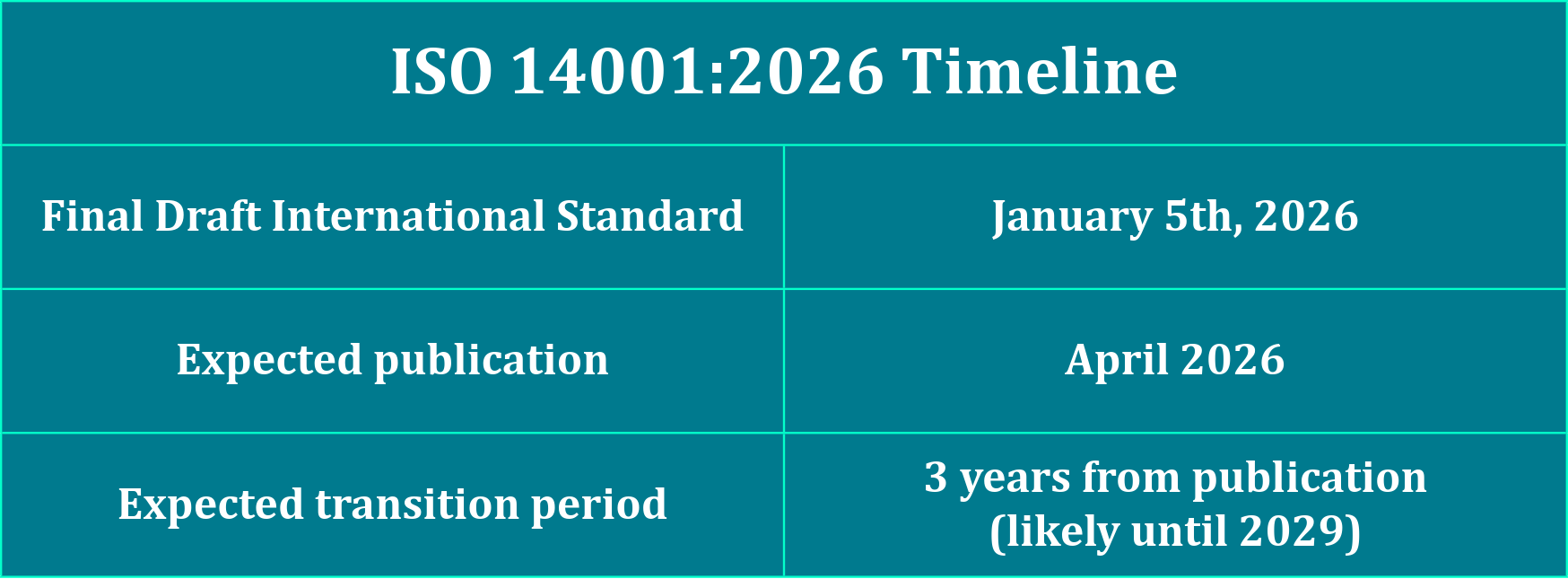
During this period, organizations must transition from ISO 14001:2015 to ISO 14001:2026 to maintain certification. IAF and Accreditation bodies will issue formal transition rules after publication, but the direction of change is already clear, creating a valuable window for organizations to begin preparing now. Early action will reduce transition pressure, support a smoother audit cycle, and give organizations the time needed to build competence, engage leadership, and implement the strengthened requirements effectively.
6. “Act Now”: A practical approach to ISO 14001:2026 transition planning
Acting early positions your organization to transition seamlessly, strengthen environmental performance, and build resilience to climate related risks. The 2026 revision represents a timely and necessary shift in environmental expectations, and organizations that begin structured preparation now will be better equipped to implement the changes effectively and confidently.
Early preparation should focus on understanding the direction of change, reviewing the emerging themes within the FDIS, assessing likely impacts on processes and governance, and identifying the competence and training needs across teams. This includes building internal knowledge, upskilling auditors and operational personnel, and ensuring leadership understands its enhanced accountability under the revised standard. Staying close to your certification body or engaging with ERM CVS provides accurate updates and informed guidance so you can plan proactively and avoid the pressure of last‑minute transition.
By preparing early, organizations can review their EMS against the confirmed requirements, conduct targeted gap assessments, and begin implementing changes that reinforce environmental accountability and operational resilience. A key part of this preparation is upskilling teams to ensure internal auditors, operational staff, and leadership understand the strengthened requirements and have the competence to apply them effectively.
7. Why the ISO 14001:2026 transition matters and how ERM CVS supports you
Transitioning to ISO 14001:2026 is more than a compliance exercise. The 2026 revision strengthens expectations around environmental governance, lifecycle thinking, supplier oversight, and alignment with broader sustainability priorities. Organizations that approach the transition proactively will be better positioned to demonstrate strong environmental performance, resilience, and responsible decision‑making.
To support this, ERM CVS offers a comprehensive transition package designed to make the process smooth, efficient, and value adding, including:
- Specialized ISO 14001:2026 transition training
Ensuring teams gain the knowledge and competence needed to interpret and apply the strengthened requirements effectively. Find out more on our ISO 14001 training courses. - Readiness reviews & transition planning
Providing a structured roadmap that identifies required updates and helps organizations implement changes with confidence. - Gap assessments (pre audit reviews)
Identify exactly where your existing EMS aligns with the new expectations and where focused improvements are needed, resulting in a targeted action plan. - Transition audits
Delivered efficiently, often alongside your annual certification audit, minimizing disruption and helping you stay on track for timely certification. Find out more on our certification services here.
8. Conclusion: preparing confidently for ISO 14001:2026
The ISO 14001:2026 revision marks an important moment for organizations to strengthen environmental governance, deepen alignment with ESG priorities, and enhance the maturity and resilience of their EMS. With the FDIS confirming focused updates across climate resilience, lifecycle thinking, leadership accountability, and change management, now is the right time to begin preparing for transition.
ERM CVS is ready to support organizations through this process with practical guidance, targeted transition training, and certification services that help teams understand the revised requirements, build internal capability, and implement changes effectively and sustainably. The countdown to publication has begun, and early preparation will enable a smoother, more confident transition to ISO 14001:2026.
Prepare early, build capability, and lead with confidence. ERM CVS will guide your transition to ISO 14001:2026 every step of the way.
Contact us now for further information
Join us on 25th February for ISO 14001:2026 FDIS webinar