

 View all
ISO 14001:2026 is now published, the first major update since 2015. The aim is to make the standard clearer, easier to apply, and more effective in practice, while maintaining the credibility that has made ISO 14001 a global benchmark.
The revision does not change the core framework; it sharpens expectations for a world where environmental performance is judged on results and an embedded part of strategy. It also reflects the last decade’s shift in the environmental and sustainability landscape: intensifying climate risk, growing biodiversity pressures, higher value-chain expectations, and greater scrutiny from regulators, customers, and investors.
At ERM CVS, we see this revision as an opportunity for environmental leadership. For organizations aiming to go beyond compliance, it is an opportunity to strengthen governance, improve decision-making, and translate environmental ambition into measurable performance and business value.
This article summarizes what has changed, why it matters, and how to approach the transition in a structured, confident way.
Why ISO 14001 still matters
ISO 14001 remains the globally recognized framework for credible environmental management. It provides an auditable foundation to manage environmental responsibilities consistently and demonstrate continual improvement, positioning a well-designed EMS as a core business tool, not a standalone compliance exercise.
A well-designed EMS helps organizations:
- Control environmental impacts consistently and in an auditable way
- Respond to complex legal and regulatory requirements
- Demonstrate credible performance to customers, regulators, and other stakeholders using measurable outcomes and evidence
- Integrate environmental risks and opportunities into governance and decision-making
With rising pressure from climate change, nature and biodiversity loss, resource constraints, and sustainability disclosures, ISO 14001 plays a key role in building resilience and maintaining stakeholder confidence.
The 2026 edition also strengthens alignment with other ISO management system standards (e.g., ISO 9001, ISO 45001, ISO 50001, and ISO/IEC 27001), with full alignment to ISO’s Harmonized Structure (Annex SL) and terminology improving compatibility, making it easier to integrate environmental management into strategy and operations and reduce duplication across governance, risk, and operational processes.
What publication of ISO 14001:2026 means for organizations
With ISO 14001:2026 now published, requirements are confirmed and the transition period begins for organizations certified to ISO 14001:2015.
Acting early gives you control: you can align transition work to business cycles and audit schedules, build capability across teams, and avoid last-minute pressure.
Early preparation also creates space to use the transition strategically, not just administratively, to strengthen environmental performance.
How significant are the changes?
ISO 14001:2026 introduces focused but meaningful enhancements that reflect how expectations have evolved since 2015. The changes improve clarity, usability, and impact, strengthening what good environmental management looks like in practice.
Requirements are more explicit on environmental context (including climate change, biodiversity, and resource efficiency) and on leadership and governance, with clearer accountability and integration into strategy. Lifecycle thinking and value-chain oversight are also reinforced, extending responsibility beyond direct operations. The update better supports both current and future expectations by requiring organizations to identify and respond to environmental risks and opportunities in a more structured and forward-looking way.
Lifecycle thinking and value chain oversight are also reinforced, recognizing the increasing interdependencies between environmental impacts across operations, the value chain, and strategic decision-making. This also supports stronger integration across environmental management, risk management, and sustainability reporting, helping organizations align evidence, controls, and disclosures rather than managing them separately.
Overall, the update keeps ISO 14001 relevant amid increasing environmental risk, transparency demands, and accountability. It also prompts organizations to reassess how environmental decisions are governed and evidenced across the EMS, creating upside for those using ISO 14001 as a performance system, not just a certificate.
Key areas organizations should focus on
ISO 14001:2026 strengthens requirements in several practical areas. Most organizations should review these first:
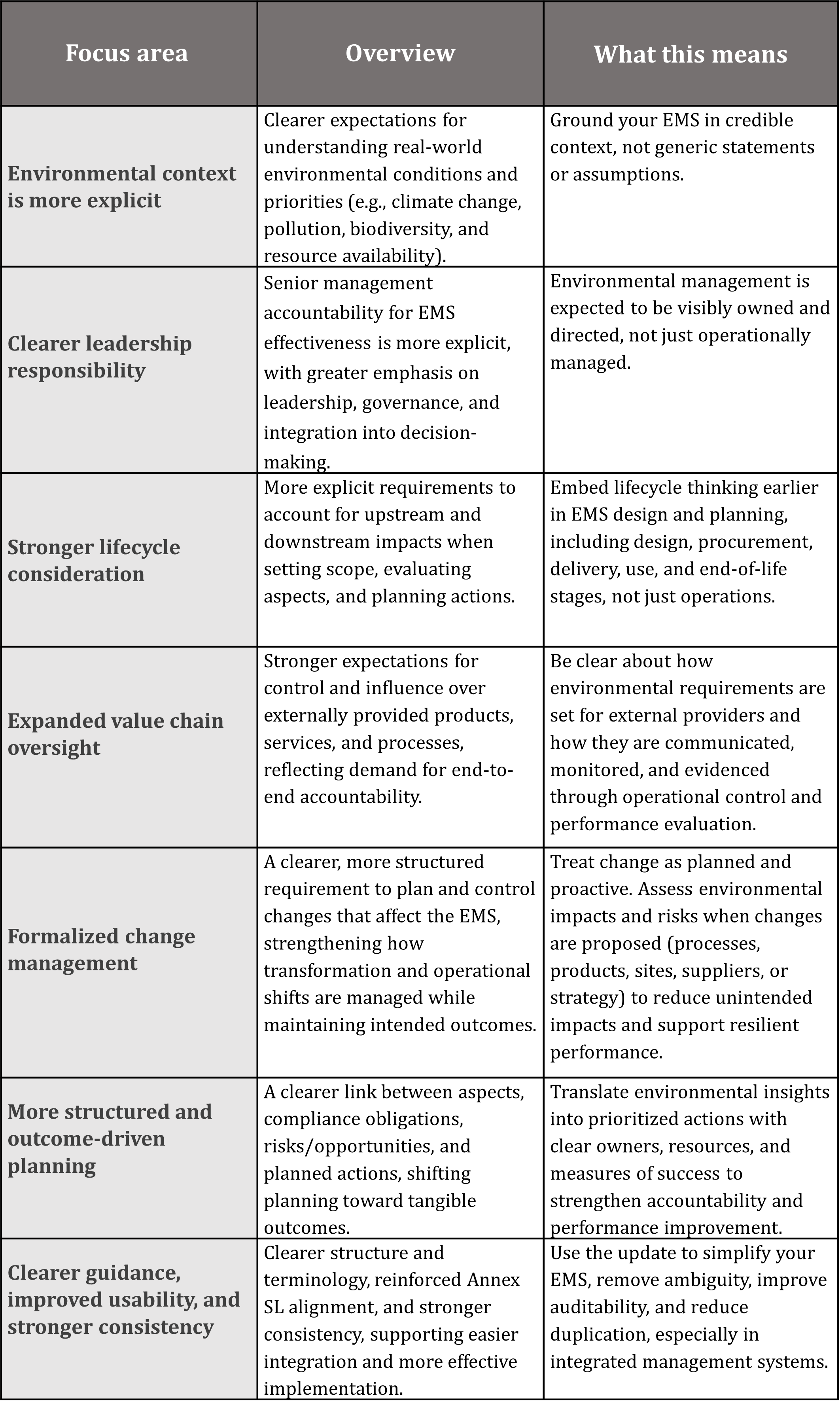
In summary: ISO 14001:2026 strengthens clarity, accountability, and consistency. For organizations ready to go beyond compliance, it provides a stronger platform for measurable environmental performance and business value.
Transition timing and practical considerations
Organizations certified to ISO 14001:2015 must transition to ISO 14001:2026 within the expected three‑year transition period, in line with international accreditation arrangements once released
Starting early helps manage workload, align changes to audit cycles, and ensure leadership and teams can apply the revised requirements.
A practical, proactive approach to transition
A high-value transition is more than a documentation update. Early actions that consistently pay off include:
- Review ISO 14001:2026 requirements and guidance in detail
- Assess impacts on governance, planning, operational control, and lifecycle/value chain management
- Identify training and competence needs across leadership, auditors, and operational teams – search our ISO 14001:2026 transition training courses
- Run a focused gap assessment and build a transition plan aligned to audit timing, considering the value creation, efficiencies and improvements you can make.
Engage early with your certification body to confirm interpretation, plan timelines, and support a smoother transition.
How ERM CVS supports ISO 14001:2026 transition
Transitioning to ISO 14001:2026 is an opportunity to strengthen environmental performance and align EMS maturity with evolving sustainability expectations.
ERM CVS supports organizations with a structured transition offering, including:
- ISO 14001:2026 transition training to build understanding and capability. Find out more on our ISO 14001 training courses.
- Readiness reviews and transition planning to establish a clear prioritized roadmap for a smooth ISO 14001:2026 transition.
- Gap assessments and pre-audit reviews to identify priority improvements and readiness for certification. Find out more on our ISO 14001 certification services here.
- ISO 14001:2026 transition audits aligned to existing certification cycles where possible to minimize disruption. Find out more on our certification services here.
As sustainability certification experts, we help organizations use the transition to strengthen environmental management and demonstrate real performance, not simply retain a certificate. Our approach supports an efficient, credible, value-driven transition.
Learn more about our transition services here
Moving forward with confidence
ISO 14001:2026 arrives at a time when environmental responsibility is increasingly defined by measurable performance. The framework is in place; the next step is action.
Organizations that prepare early will be best positioned to meet transition requirements smoothly and use the revision to improve governance, strengthen environmental performance, and create lasting business value.
Contact ERM CVS to discuss your transition pathway, access our transition services, and use ISO 14001:2026 to further strengthen environmental performance.
Contact us now for further information